NRIs and Global Investors Are Buying Indian Real Estate at Record Pace — Here Is Why Pune Is Their First Choice

whatsapp image 2026 04 16 at 3.08.16 pm

A major investment advisory statement issued April 13, 2026 confirms that NRI and global investor demand for Indian real estate has hit a new high, with the sector on track to reach $1 trillion by 2030. The rupee, India’s GDP trajectory, lower home loan costs and Pune’s IT-professional workforce are combining to make this city one of the most compelling real estate investment destinations on the planet for the Indian diaspora right now.

Advertisements

Carpet Rates Investment Desk·April 15, 2026·Global Investment·8 min read·Source: CNW / Yahoo Finance · April 13, 2026

NRI & Global Investment · India Real Estate · April 13, 2026Source: CNW / Yahoo Finance / IBEF

On April 13, 2026, an investment advisory statement distributed via CNW and picked up by Yahoo Finance, Globe and Mail and multiple financial newswires confirmed what India’s real estate market has been experiencing on the ground for the past 18 months: Non-Resident Indians and international investors are flooding back into Indian property at a pace that has not been seen in years. The statement pointed to India Brand Equity Foundation (IBEF) projections estimating that India’s real estate sector will reach nearly one trillion dollars in value by 2030 — a milestone that would make it one of the largest property markets on the planet.

For Pune’s real estate market — where NRI purchases already represent a meaningful share of premium and luxury segment transactions — this global resurgence of interest has direct and concrete implications. Understanding what is driving it, and what it means specifically for Pune buyers and sellers, is the purpose of this article.

$1 Trillion

India’s real estate sector projected value by 2030 — per IBEF projections cited in the April 13, 2026 advisory

$1.2B

Domestic PE investment in Indian real estate in Q1 2026 alone — surging 57% YoY as Indian capital leads foreign capital for the first time

Why NRIs Are Buying Now — The Four Forces

The surge in NRI investment in Indian real estate is not driven by sentiment or nostalgia. It is driven by a convergence of four hard financial factors that have aligned in 2025–26 in a way that makes Indian property unusually attractive to overseas buyers.

1. The currency advantage. The Indian rupee has depreciated against major reserve currencies over the past several years. For an NRI earning in US dollars, British pounds or UAE dirhams, this depreciation is a direct asset purchase discount. An apartment that cost ₹1 crore in 2020 — roughly $13,700 at 2020 exchange rates — would require roughly $11,500 today at the current exchange rate, representing an effective 16% discount in dollar terms even if the rupee price has risen. This currency tailwind makes Indian property cheaper in hard currency terms than at almost any point in the last decade.

2. India’s GDP trajectory. India’s economy grew at 7.8% in Q1 FY26 and 8.2% in Q2 FY26 — among the fastest growth rates of any large economy in the world. Property values, over the medium and long term, broadly track economic growth. Buying real estate in an economy growing at 8% annually offers a fundamentally different return profile than buying in a slow-growth western economy. NRIs with long investment horizons — 7 to 15 years — are making a GDP bet when they buy Indian property, and the GDP numbers justify that bet.

3. Home loan affordability. The RBI’s 125 basis point rate cut cycle through 2025 — bringing the repo rate to 5.25% — has made home loans significantly more affordable for Indian resident buyers. But NRIs buying for investment or future occupancy also benefit from this rate environment, since the yield arithmetic on rental properties improves when borrowing costs fall and when resident buyer demand increases. Lower rates stimulate end-user demand, which supports both rental yields and capital appreciation — both of which improve the NRI investor’s return.

4. Premium housing supply alignment. NRI buyers disproportionately target premium and luxury properties — larger flats, gated communities, branded developer projects, properties with strong rental demand from corporate tenants. India’s premium housing market is precisely the segment that has been the most active in 2025–26, with new launches, strong developer pipelines and genuine buyer depth. The supply that NRIs want is being built at scale right now.

Why Pune Specifically — The NRI Investment Case

Within India’s NRI investment landscape, Pune holds a distinctive position that is worth articulating clearly. The city is not the most glamorous NRI destination — that remains Mumbai’s South Bombay and Bengaluru’s premium localities. But Pune may be the most rational NRI investment choice in India right now, and the data supports this claim on multiple dimensions.

The rental yield advantage. Pune’s residential rental yields — running at 3.5–4.5% in prime IT corridors and up to 4.2% in localities like Viman Nagar — significantly outperform Mumbai’s 2.5% average. For an NRI buying purely as an investment with the intention of renting the property to IT professionals or corporate tenants, the monthly income relative to purchase price is better in Pune than in almost any comparable Tier-1 Indian city.

The tenant quality.** Hinjewadi alone employs over 4 lakh IT professionals. Kharadi, Magarpatta, Baner and Aundh together house the offices of virtually every major global IT firm, BFSI company and GCC operator active in India. These are high-income, stable-employment tenants who pay on time, maintain properties well and provide the kind of rental security that NRI landlords — managing properties from overseas — depend on.

The price-to-income value. Compared to Mumbai (where a 1,000 sqft flat in a decent locality costs ₹2–4 crore) and Bengaluru (₹1.5–3 crore in comparable localities), Pune offers similar employment catchment, better infrastructure investment trajectory and lower absolute prices. At ₹7,850–10,200 per sq.ft. in corridors like Hinjewadi and Baner — versus ₹18,000–25,000 per sq.ft. in Bengaluru’s premium belt — Pune’s relative value proposition for the NRI buying at the ₹1–2 crore price point is compelling.

The infrastructure inflection. The Metro Line 3 launch in May 2026, the Ring Road’s western corridor completion and the Purandar Airport project are all infrastructure events that NRI investors are pricing into their long-term return models. NRIs who bought in Hinjewadi Phase 1 and Wakad in 2021–2022 at ₹5,500–6,500 per sq.ft. are now sitting on 20–25% appreciation with rental income on top. The next infrastructure catalyst — the full Metro Line 3 and Ring Road connectivity — is already in the pipeline.

Why NRIs Choose Pune

Why NRIs Choose PuneData PointComparison City
Rental yield3.5–4.5% residential▲ vs Mumbai 2.5%
Entry price (prime)₹7,850–10,200/sqft▲ vs Bengaluru ₹15,000–25,000
IT workforce (tenants)4 lakh+ in Hinjewadi aloneComparable to any Indian city
Price appreciation (2yr)+18–20% in Hinjewadi/Wakad▲ Strong outperformance
Infrastructure catalystMetro Line 3 May 2026Most imminent of any Indian city
RERA complianceMaharashtra — among best in IndiaStronger than many states

The Foreign Investment Puzzle — And Why It Actually Reinforces the Story

One complicating data point in the April 2026 picture is the Colliers India report showing that foreign investment in Indian real estate fell approximately 75% in Q1 2026 compared to Q1 2025. This seems to contradict the NRI investment surge narrative. It does not — and understanding the distinction matters.

Foreign institutional investment (PE funds, sovereign wealth, REITs) and NRI individual investment are entirely different flows. Foreign PE funds pulled back in Q1 2026 due to global macro uncertainty — the West Asia conflict, crude oil volatility and the resulting caution about emerging market allocations. That foreign institutional retreat is well-documented and real.

But NRI individual buyers — who purchase completed or under-construction residential units, not institutionally structured office park stakes — operate on completely different time horizons and decision frameworks. An NRI software engineer in Toronto buying a 2 BHK in Wakad for ₹90 lakh is not making the same decision as a Singapore PE fund deciding whether to allocate $200 million to a Gurugram office park. The foreign institutional dip and the NRI individual surge can and do coexist — they are different market participants responding to different signals.

The Whalesbook institutional data reinforces this: domestic capital (which includes NRI and diaspora money channelled through Indian entities) surged 57% to $1.2 billion in Q1 2026, driving total institutional investment up 25% year-on-year even as foreign institutional capital fell. The Indian real estate market is becoming more self-reliant — and NRI capital is part of that self-reliance story.

NRI Investor Checklist for Pune Property

Best localities for rental yield: Hinjewadi Phase 1 & 2, Viman Nagar, Kharadi, Baner, Wakad

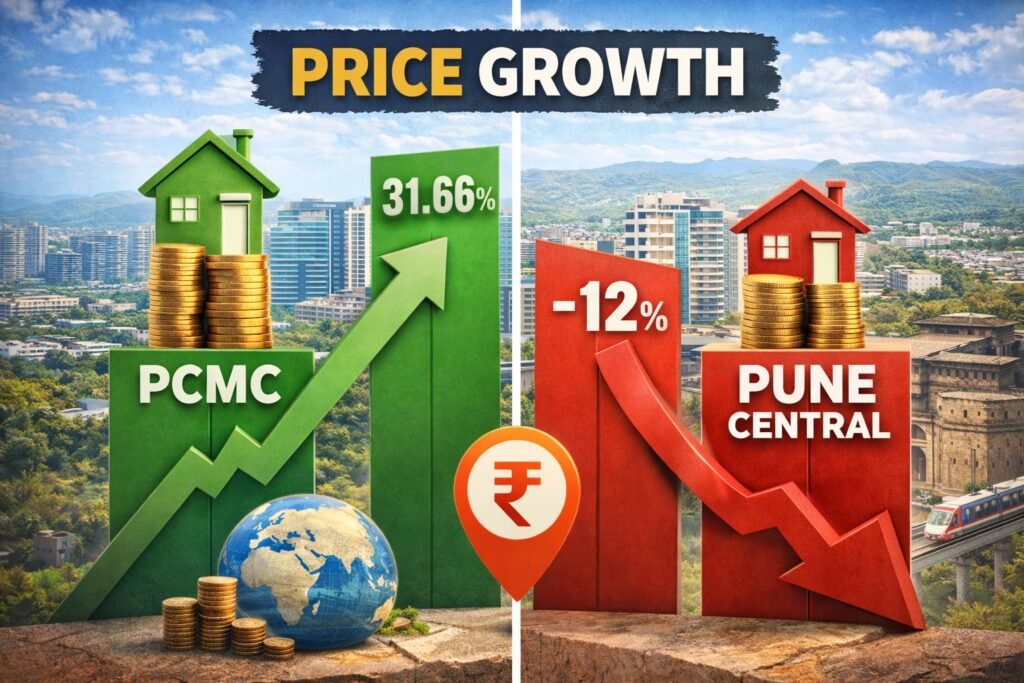
Best localities for capital appreciation: Wakad (metro corridor), Undri (emerging), PCMC (highest recent appreciation at 31.66%)

Best price point for NRI investment: ₹80 lakh – ₹1.5 crore (2 BHK in IT corridors) — highest rental demand, most liquid resale market

FEMA compliance: NRIs can purchase residential property in India freely. Repatriation of rental income and sale proceeds subject to FEMA guidelines — consult a CA or FEMA specialist before transacting

Developer recommendation: Stick to RERA-registered projects from listed or nationally branded developers for overseas purchase security

India’s real estate sector reaching $1 trillion by 2030 is not a speculative projection — it is a mathematical extrapolation of current growth rates and capital flows. The NRI community, spread across the UAE, USA, UK, Canada and Southeast Asia, represents a reservoir of motivated, financially capable buyers who have a cultural and emotional connection to Indian property that no algorithmic investment model can fully capture.

For Pune, a city whose IT workforce has seeded diaspora communities across every major global technology hub, the NRI buyer is not an abstract market participant. They are the brother of someone who works in Hinjewadi, the parent of an engineer in Kharadi, the former colleague of a professional now in Baner. They know the city. They trust the market. And in April 2026, the financial case for them to act is as strong as it has been in years.

Primary Source: CNW / Yahoo Finance / Globe and Mail Investment Advisory Statement, April 13, 2026 — NRI & Global Investor Demand Report

Supporting Sources: IBEF India Real Estate Sector Projections · Whalesbook — Domestic Capital Dominates Q1 2026 (April 2026) · Colliers India Q1 2026 Investment Report · Cushman & Wakefield India Outlook 2026 · BPTP NRI Investment Guide 2026 · Prateek Group NRI Investment Analysis

Disclaimer: This article is for informational purposes only and does not constitute investment, legal or tax advice. NRI property investment in India is subject to FEMA regulations, RBI guidelines and Indian tax law. Please consult a SEBI-registered advisor, FEMA specialist and tax professional before making property investment decisions.

NRI InvestmentGlobal InvestorsPune Real Estate

Leave a Comment

Your email address will not be published. Required fields are marked *