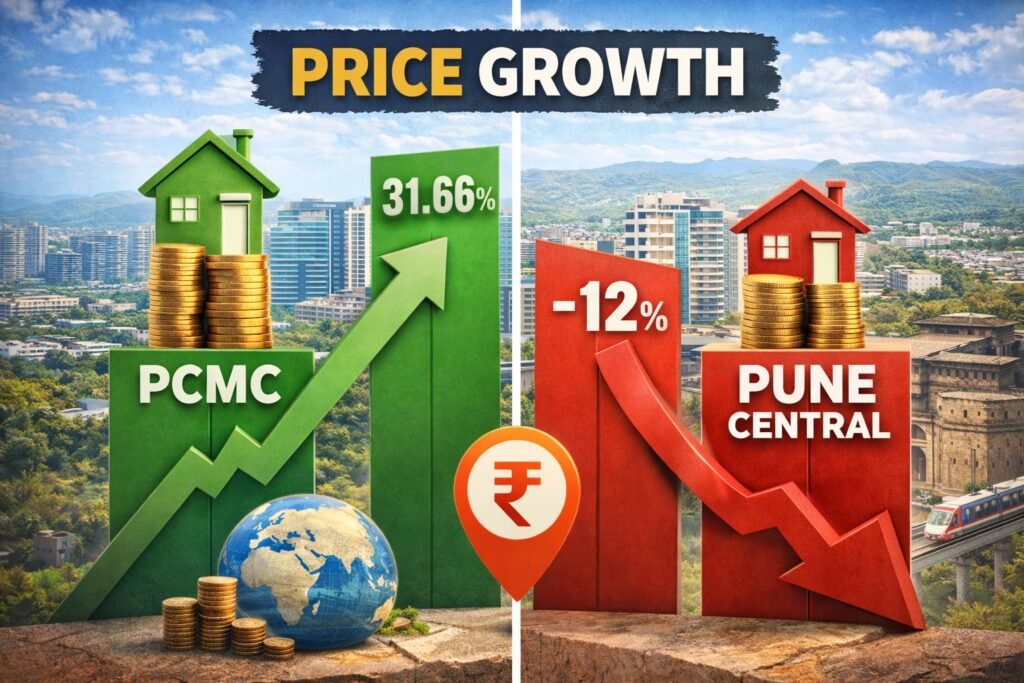
The latest verified registration and price data for April 2026 reveals a split inside Pune’s market that has no modern precedent: Pimpri-Chinchwad (PCMC) appreciated 31.66% year-on-year while Pune Central declined 12.04%. This is not a rounding error. It is the visible outcome of infrastructure momentum, manufacturing sector expansion, relative affordability, and a buyer population that has made a collective decision about where value lies in western Maharashtra’s biggest city.

Carpet Rates Price Intelligence Desk·April 16, 2026·Price Intelligence · Breaking·9 min read·Source: Square Yards Data Intelligence · Cushman & Wakefield · Pune Realty Hub · April 2026
Pune vs PCMC Price Divergence · April 2026 · Square Yards Data IntelligenceSource: Square Yards / Cushman & Wakefield
When two parts of the same city post a 43-percentage-point gap in annual property appreciation — one surging 31.66%, the other declining 12.04% — the market is not making a noise. It is making a statement. The April 2026 price data from Square Yards’ Data Intelligence platform, cross-referenced with Cushman & Wakefield’s Q1 2026 Pune MarketBeat, reveals exactly this: Pimpri-Chinchwad (PCMC) and Pune Central are no longer the same market in any meaningful sense. They are diverging stories, with diverging fundamentals, attracting diverging buyer profiles.
Understanding this split — why it happened, where it is heading, and what it means for every buyer and investor currently evaluating Pune — is the most important analytical task in the city’s real estate market right now. Because the divergence is not a temporary anomaly. It reflects structural forces that have been building for three years and are now producing visible, quantifiable outcomes in registration data and transaction prices.
+31.66%
PCMC (Pimpri-Chinchwad) year-on-year price appreciation — the strongest performance of any major Pune zone in the April 2026 data
−12.04%
Pune Central year-on-year price change — driven by correction pressure in over-priced legacy stock and declining new-launch competitiveness
The PCMC Story — Why the City’s Industrial Belt Is Now Its Hottest Real Estate Market
PCMC — the municipal body governing Pimpri, Chinchwad, Akurdi, Nigdi, and the broader industrial belt north and west of central Pune — has historically been considered the city’s blue-collar sibling. Lower prices, lower prestige, lower profile. The image was built on the reality of Pimpri-Chinchwad’s industrial origins — the Bhosari MIDC, the Chakan manufacturing corridor, the auto and pharma factories that built the zone’s employment base from the 1970s onward.
In 2026, that image is not just outdated. It is actively costing buyers money to hold on to it. The PCMC that generated 31.66% annual price appreciation is not a blue-collar backwater. It is a zone that has: access to the Chakan industrial corridor (home to Volkswagen, Bajaj, Mercedes-Benz and 4,000+ ancillary units); a rapidly expanding IT presence in Wakad, Punawale, and the Hinjawadi Phase 3 fringe that falls under PCMC governance; direct connectivity to Metro Line 3 stations at Wakad and Tathawade; and a price base that, relative to PMC-governed Baner or Kothrud, still offers meaningful affordability.
The Cushman & Wakefield Q1 2026 data identifies PCMC-adjacent submarkets as the city’s most active for new launches. The Hinjawadi NH4 North belt — which straddles the PCMC-PMRDA boundary — contributed 33% of all Pune’s Q1 2026 residential launches. Developers including Kolte-Patil, VTP Realty, and Goel Ganga have been driving significant volume in this zone, bringing institutional-quality projects to price points that remain competitive relative to the city’s established corridors.
What PCMC’s 31.66% Means in Real Money
Let us make this concrete. The current PCMC average transaction price, per Square Yards data, is approximately ₹12,226 per sq.ft. A 31.66% annual appreciation means that a buyer who purchased a 1,000 sq.ft. flat in PCMC 12 months ago at ₹9,290 per sq.ft. (₹92.9 lakh) is now sitting on an asset worth approximately ₹12,226 per sq.ft. — or ₹1.22 crore. That is a ₹29.3 lakh capital gain in 12 months on a single residential property, before factoring in rental income.
For context: the Pune-wide average residential asking price stands at ₹12,961 per sq.ft. as of April 2026, with a registered transaction rate of ₹8,704 per sq.ft. PCMC, at ₹12,226 per sq.ft., is now virtually at parity with the city-wide asking price average — a convergence that would have seemed implausible five years ago. The discount that buyers historically demanded for choosing PCMC over PMC is compressing. In some micro-markets like Wakad and Ravet, it has already disappeared.
| Pune Zone | Average Price (Apr 2026) | YoY Change | Key Drivers |
| PCMC | ₹12,226/sqft | ▲ 31.66% | Manufacturing, IT spillover, Metro Line 3, affordability |
| Pune East | ₹13,391/sqft | ▲ 17.44% | Airport proximity, Kharadi IT, Viman Nagar premium |
| Pune West | ₹13,053/sqft | ▲ Moderate | Baner, Kothrud established demand, metro corridor premium |
| Pune Central | ₹16,140/sqft | ▼ −12.04% | Legacy stock overhang, affordability ceiling, limited new launches |
| City-wide Average | ₹12,961/sqft (ask) | ▲ Positive | Diversified — strongest in PCMC and East corridors |
Why Pune Central Is Declining — And Why This Is Not a Danger Signal for the City
The −12.04% price decline in Pune Central requires careful interpretation. Pune Central — broadly encompassing the Deccan Gymkhana, Shivajinagar, Camp, and Koregaon Park-adjacent areas at the city’s historic core — has an average asking price of ₹16,140 per sq.ft. That is roughly 32% above the city-wide average, and in many subclusters of Pune Central, the premium is significantly higher. Deccan Gymkhana premium properties, per Square Yards data, transact at ₹30,000+ per sq.ft.
The correction in Pune Central is not a sign of fundamental demand weakness. It is a sign of price rationalisation. Properties that were priced at ₹18,000–22,000 per sq.ft. during the peak of the post-pandemic demand surge in 2022–2023 are correcting toward levels that buyers at the top of Pune’s income pyramid — the people who can actually afford Pune Central — are willing to validate. In a city where an IT senior professional earning ₹30–40 lakh per annum is the aspirational buyer for this zone, a ₹2 crore flat (at ₹20,000 per sq.ft. for 1,000 sq.ft.) demands an EMI that stretches even this income level uncomfortably.
The −12.04% is the market correcting toward a clearing price — the price at which genuine buyers will transact. For buyers who have long coveted Pune Central addresses but found the 2022–2023 peak prices inaccessible, the current correction is not a danger signal. It is an entry window. The key is distinguishing between the legacy resale stock that is correcting and the few new launches in this zone — which remain scarce and tend to hold value better due to their modern specifications and limited supply.
“PCMC’s stronger year-on-year growth reflects the relative affordability of the Pimpri-Chinchwad belt and the Hinjewadi-Wakad-Punawale demand driven by IT and manufacturing sector employment. New-launch activity in PCMC has been particularly strong, with Kolte-Patil, VTP Realty, and Goel Ganga driving significant volumes.”
— Pune Realty Hub Market Analysis, Q1 2026
The Investment Case — Where the Divergence Leads in the Next 12–24 Months
If the PCMC vs Pune Central divergence continues at even half its current pace over the next 12–24 months, the investment implications are significant. PCMC has three remaining tailwinds that have not yet fully materialised in prices: the Metro Line 3 full network completion (July 2026) which connects PCMC-adjacent Wakad and Tathawade into the citywide metro grid; the Ring Road western corridor completion which opens peripheral PCMC land to development at new price points; and the continued expansion of the Chakan manufacturing corridor, where global auto and electronics manufacturers are continuing to add capacity and employment.
Each of these is an independently verifiable, physically under-construction infrastructure event — not a speculation or projection. They are happening. The only question is the pace at which they translate into registered transaction prices. PCMC’s 31.66% appreciation in the trailing 12 months suggests the market is already pricing them in with conviction.
For Pune Central, the stabilisation of prices after the current correction cycle — likely 12–18 months — will be driven by scarcity. New launches in Pune Central are inherently constrained by land availability. Once the resale correction exhausts itself, the absence of significant new supply in this zone will provide a natural price floor. Buyers with a 5-year horizon who purchase Pune Central at today’s corrected prices are likely to see meaningful appreciation when the zone’s supply scarcity reasserts itself.
The Divergence in Numbers — April 2026 Snapshot
PCMC current average: ₹12,226/sqft (+31.66% YoY) | Pune Central current average: ₹16,140/sqft (−12.04% YoY) | City-wide asking average: ₹12,961/sqft | Registered transaction average: ₹8,704/sqft | Best yield zone: Ravet (PCMC) at 4.3% gross residential yield | Strongest launch corridor: NH4 North / Hinjawadi fringe | Best contrarian entry: Pune Central legacy resale — currently at deepest discount in 4 years | 52,766 transactions registered between May 2025 and April 2026, generating ₹43,466 crore in gross value — proof of depth
Pune’s property market in April 2026 is not a single story. It is a collection of micro-stories playing out simultaneously — PCMC accelerating, Pune East holding firm, Pune West riding the metro premium, and Pune Central rationalising from an over-extended peak. The buyer who treats Pune as one market and makes a decision based on the city-wide average will systematically miss the signal. The buyer who reads the zone-level data — PCMC at 31.66%, Pune Central at −12.04% — and acts with precision is operating in a market that is, right now, offering more informed-buyer advantages than at any point in the past four years.
Primary Sources: Square Yards Data Intelligence — Property Rates in Pune, April 2026 · Cushman & Wakefield Pune MarketBeat Q1 2026, April 2026
Supporting Sources: Pune Realty Hub — Pune Property April 2026 Market Update · JLL Homes — Pune Registration Data Analysis 2025–2026 · Business News This Week — Pune & PCMC Housing Markets 2026 · Colliers India Q1 2026 Office Report
Disclaimer: This article is for informational purposes only and does not constitute investment, legal or financial advice. All price data sourced from institutional research platforms and may differ from individual project transaction prices. Conduct independent due diligence before making property investment decisions.
PCMCPune CentralPrice DivergencePimpri-ChinchwadMarket IntelligencePrice AppreciationRavet